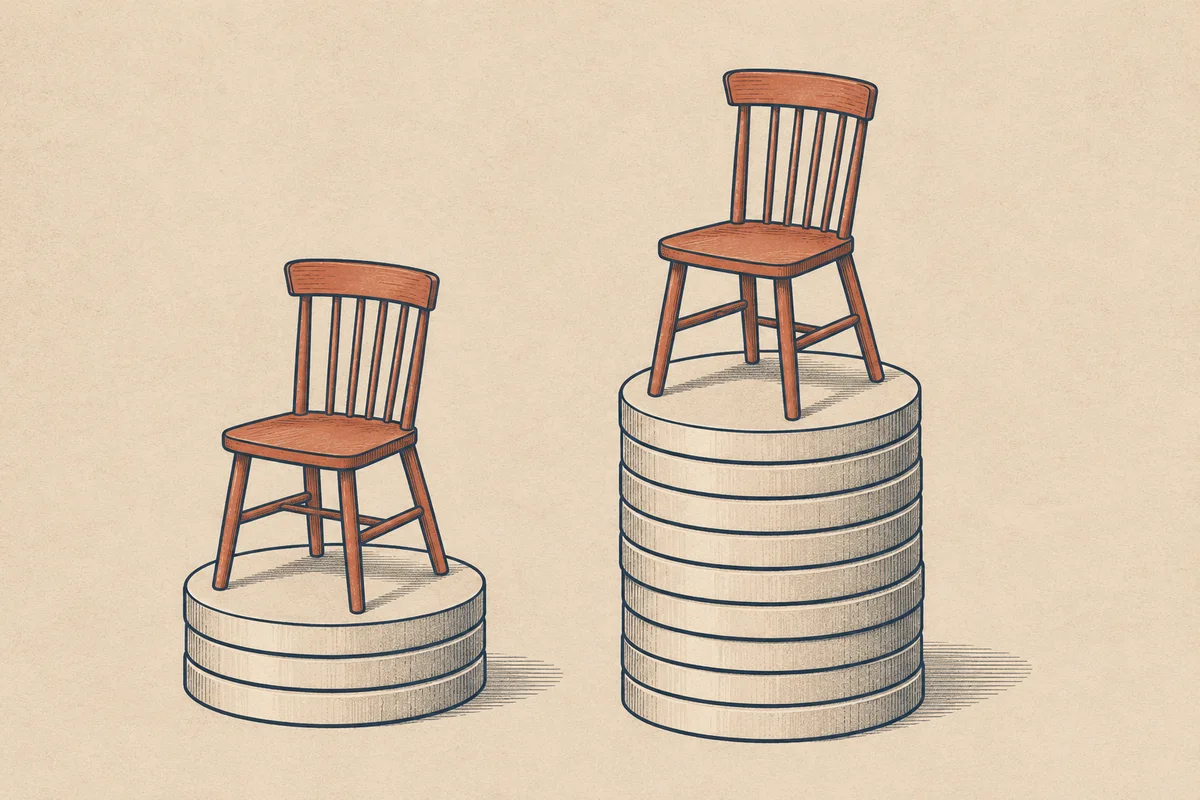
Imagine two businesses.
Both make £1 million in annual operating profit.
One required £5 million of capital to build.
The other required £50 million.
Which is the better business?
At first glance, they appear equally profitable.
But the first generates ten times as much operating profit for every pound of capital tied up in the operation.
That difference is fundamental.
It explains why some businesses create enormous value through growth, while others become larger, busier and increasingly impressive without making their owners much better off.
The concept is called return on invested capital, or ROIC.
And it is one of the most useful ways to understand whether a company is genuinely good at turning investment into economic returns.
So, let's jump in.
Profit tells you what you earned. ROIC tells you what it took.
Companies regularly announce rising revenue and record profits.
These figures matter.
But they do not tell you how much capital was required to produce those results.
A business might generate £10 million in operating profit from £50 million of invested capital.
Another might generate the same profit from £500 million.
Those are very different economic propositions.
Return on invested capital measures the relationship between operating profit after tax and the capital invested in the business.
A commonly used formula is:
ROIC = net operating profit after tax ÷ average invested capital
Net operating profit after tax is often abbreviated to NOPAT.
It represents the profit generated by operations after an appropriate tax charge, before financing effects.
Invested capital generally includes the operating assets financed by shareholders and lenders, less relevant non-interest-bearing operating liabilities. Analysts may use different definitions and adjustments.
The important principle is straightforward.
How much operating profit does the company generate from the capital committed to producing it?
Meet Extremely Ambitious Furniture Ltd
Our fictional company manufactures attractive office furniture.
Its marketing department describes the products as transformative workplace solutions.
Its customers mostly describe them as desks.
The company has £10 million of invested operating capital.
It generates £1.5 million in operating profit before tax.
Assuming a 25% tax rate, its net operating profit after tax is £1.125 million.
Its ROIC is therefore:
£1.125m ÷ £10m = 11.25%
That is useful information.
But whether 11.25% is attractive depends on another figure: the company's cost of capital.
The cost of capital: Money is not free
Businesses require funding.
Some comes from shareholders. Some may come from lenders.
Both expect a return.
Lenders charge interest. Shareholders accept risk because they expect to earn an adequate return over time.
The company's weighted average cost of capital, or WACC, estimates the blended cost of these financing sources.
It is not a perfectly observable number. It depends on assumptions about risk, financing structure and market conditions.
For our example, let's assume a WACC of 9%.
Our furniture company earns an 11.25% ROIC.
Its return exceeds its estimated cost of capital by 2.25 percentage points.
That positive difference suggests the business is creating economic value from its invested capital.
Now imagine a second company earning a 6% ROIC with the same 9% cost of capital.
It may still report positive accounting profits.
But its returns are below what its capital providers require.
In economic terms, it may be destroying value.
A business can be profitable and still be a poor use of capital.
That sounds contradictory until you remember that money has alternative uses.
Why growth can make a bad business worse
Suppose Extremely Ambitious Furniture Ltd wants to double in size.
Management proposes investing another £10 million in factories, equipment and working capital.
There are two possible outcomes.
Same £10m investment. Two different outcomes.
| Measure | Scenario A | Scenario B |
|---|---|---|
| Return on new capital | 15% | 5% |
| Annual NOPAT generated | £1.5m | £500k |
| Difference from the assumed annual capital charge | £600k above the assumed £900k annual capital charge | £400k below the assumed £900k annual capital charge |
In both scenarios, revenue and accounting profit may increase.
But only the first investment earns more than the assumed cost of capital.
In the second scenario, management has successfully grown the business while making its economic returns less attractive.
This is a surprisingly common strategic temptation.
Expansion is visible. New factories are impressive. Revenue growth looks excellent in presentations.
Declining returns on capital are rather less photogenic.
The crucial difference between average and incremental returns
There is another complication.
A company may report an excellent historical ROIC but have fewer attractive opportunities for new investment.
Its existing operations might generate outstanding returns.
Yet expanding into new markets, products or acquisitions could produce much weaker results.
This is why investors should consider both:
Average ROIC: How efficiently does the existing business use its invested capital?
Incremental return on invested capital: What return does the company earn on additional capital committed to growth?
The second question is especially important for businesses pursuing aggressive expansion.
A company with a strong established operation may create more value by improving existing assets, distributing excess cash or selectively investing than by opening additional facilities simply because it can.
Growth is not automatically a virtue.
Sometimes restraint is the more commercially ambitious decision.
Why this matters for different types of businesses
Consider three broad operating models.
A software business may need substantial initial development spending but relatively modest additional capital to serve more customers. If demand is strong, returns on incremental capital can become attractive.
A supermarket may require premises, inventory, refrigeration, distribution and employees. Its operating margins may be modest, making capital efficiency particularly important.
An industrial manufacturer may need expensive machinery and facilities before it can increase production.
None of these models is inherently superior.
A capital-intensive company can be excellent if it earns attractive returns on its assets.
An apparently capital-light company can be disappointing if it continually spends heavily on acquisitions, customer acquisition or development without generating sustainable returns.
Accounting treatment also matters.
Some expenditure is recognised immediately as an expense, while other spending is capitalised and depreciated over time.
That can make reported ROIC difficult to compare across industries without adjustments.
The number is a useful starting point, not a universal ranking system.
The limitations: ROIC is not a crystal ball
Return on invested capital has several weaknesses.
First, invested capital can be measured differently. Goodwill, acquired intangible assets, leases, excess cash and restructuring charges can affect comparisons.
Second, historical ROIC may not reflect the economics of future investments.
Third, a company may temporarily report weak returns while developing an asset that could become highly profitable later.
Fourth, inflation and old assets can distort accounting values. A company operating facilities purchased decades ago may appear to generate unusually high returns because the recorded asset base is low.
And finally, ROIC does not tell you whether a company's shares are attractively priced.
An excellent business can still be a disappointing investment if you pay too much for it.
That distinction is essential.
Business quality and investment valuation are related, but they are not interchangeable.
Three things to remember
- Profit without capital context tells only half the story. Ask how much money the business needed to generate its earnings.
- Growth creates value when returns exceed the cost of capital. Increasing revenue and profit is not sufficient if additional investment earns inadequate returns.
- Future returns matter more than historical prestige. A company with excellent existing operations can still make poor expansion decisions.
The next time management announces an ambitious investment programme, ask three questions.
How much capital will it require?
What additional operating profit should it generate?
And will that return justify the money committed?
Because building a bigger business is an achievement.
Building one that makes better use of its capital is something rather more interesting.