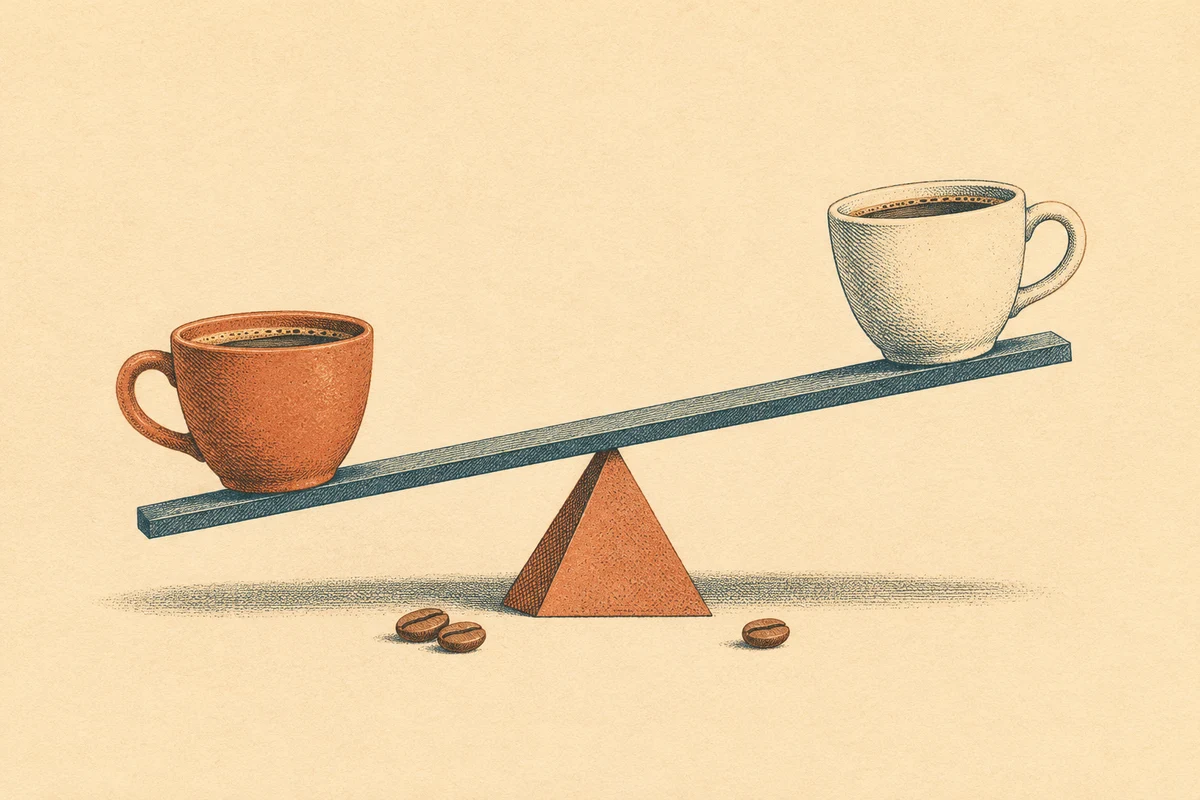
Imagine opening a coffee shop. You've rented the premises, bought a coffee machine and employed someone who can explain the difference between a flat white and a cappuccino without appearing personally offended by the question. Whether you sell ten coffees or a thousand, your landlord remains remarkably consistent in their expectations.
Once you've sold enough coffee to cover your fixed costs, each extra cup can make a surprisingly large contribution to profit. This is operating leverage. It explains how a modest change in sales can have a dramatic effect on profit.
So, let's jump in.
Two types of cost
Fixed costs do not change directly with the number of products sold, within a given period and operating range. Rent, insurance and some staffing costs are examples.
Variable costs change with production or sales volumes. Coffee beans, milk, takeaway cups and certain transaction charges are examples.
Contribution per coffee = Selling price − variable cost.
Each coffee contributes that amount towards paying fixed costs. Once those costs are covered, the contribution from each extra sale goes towards profit.
Introducing Rather Good Coffee Ltd
Let's imagine a fictional coffee shop with the following monthly economics:
| Item | Assumption |
|---|---|
| Selling price per coffee | £4 |
| Variable cost per coffee | £1 |
| Contribution per coffee | £3 |
| Monthly fixed operating costs | £6,000 |
Price and unit variable cost stay constant, fixed costs stay at £6,000 and the example excludes financing costs and tax. How many coffees cover the shop's operating costs?
Break-even volume = £6,000 ÷ £3 = 2,000 coffees.
At 2,000 coffees, operating profit is zero. Those coffees have effectively been working for the landlord and covering the shop's other operating expenses. Coffee number 2,001 finally gets to do something for the owner.
Where things become interesting
Suppose the shop sells 2,500 coffees in a month and makes £1,500 in operating profit. What changes if it sells 3,000 the following month?
| Measure | 2,500 coffees | 3,000 coffees |
|---|---|---|
| Revenue | £10,000 | £12,000 |
| Variable costs | £2,500 | £3,000 |
| Fixed operating costs | £6,000 | £6,000 |
| Operating profit | £1,500 | £3,000 |
Sales rise by 20% and operating profit doubles. Each extra coffee contributes £3 because the original 2,500 sales already covered the shop's fixed costs.
And now the unpleasant bit
Operating leverage works in both directions. At 2,200 coffees a month, the shop makes £600 in operating profit. A 10% increase in volume takes sales to 2,420 coffees and profit to £1,260, a 110% increase.
But a 10% decrease takes volume down to 1,980 coffees, below break-even. The business now makes a £60 operating loss, a 110% fall from its starting profit.
Try it with the operating leverage calculator
Rather Good Coffee Ltd starts at 2,200 coffees a month and £600 in operating profit.
- Monthly coffees sold
- 2,420
- Monthly revenue
- £9,680
- Monthly operating profit
- £1,260
- Change in operating profit
- +110%
The products and prices are the same. The landlord is still displaying admirable consistency. A small movement in sales makes such a big difference because the shop starts so close to break-even.
Can we measure operating leverage?
The degree of operating leverage measures how sensitive operating profit is to sales. At a given starting volume, divide total contribution by operating profit.
Degree of operating leverage = Total contribution ÷ operating profit.
At 2,500 coffees, total contribution is £7,500 and operating profit is £1,500. Divide £7,500 by £1,500 and you get 5. Under our assumptions a 1% change in sales volume from that starting point produces a 5% change in operating profit.
At 2,200 coffees the degree of operating leverage is 11. The closer the shop gets to break-even, the more sensitive its profits become to changes in sales. At break-even itself, operating profit is zero, so the formula is undefined.
Why investors should care
An airline incurs many of the same costs to operate a scheduled flight whatever the number of seats occupied. A manufacturer might have an expensive factory capable of producing much more than it currently sells. Filling empty capacity can lift profit quickly. When demand falls, those bills still need paying.
If a company reports strong profit growth, ask what changed. Growing market share and filling spare capacity can both raise profits, but the latter offers a finite boost. The next round of growth might need a new factory.
How debt changes the picture
Operating leverage comes from the structure of operating costs. Financial leverage comes from debt and other financing obligations. A highly indebted business with high fixed operating costs can be especially exposed when sales fall, because it still has interest to pay after operating profit has shrunk.
The limits of the model
Our coffee shop is suspiciously well behaved. Its selling price never changes, ingredients cost the same and it can serve extra customers without employing another member of staff or buying another machine.
A growing company may need to expand its capacity and take on higher fixed costs. Falling sales might prompt discounting, which reduces the contribution from each transaction. Company accounts may give investors only a rough idea of which costs move with sales.
Three things to remember
- Fixed costs amplify changes in profit. Once they are covered, additional sales can contribute disproportionately to operating profit.
- The mechanism works both ways. A modest fall in demand can eliminate profits, particularly when a business is close to break-even.
- Ask how growth is being achieved. Higher sales from existing capacity can have very different economics from growth requiring expensive new infrastructure.
The next time a company announces that profits have doubled, look beyond the headline. It may have discovered a wonderful new competitive advantage. Or it may simply have sold enough extra coffees to make the landlord considerably less interesting.