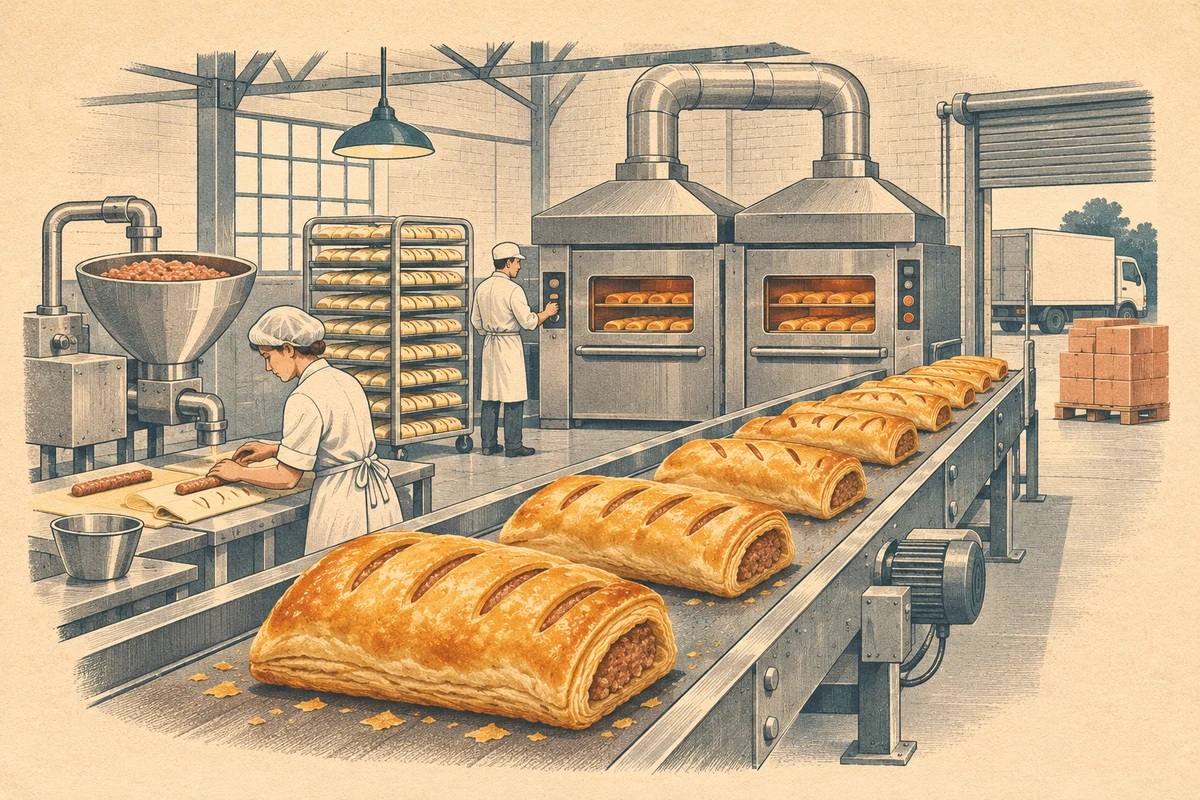
There are businesses that sell products, businesses that sell experiences, and businesses that sell you something warm for lunch before you have had sufficient time to reconsider your nutritional ambitions. Greggs has built an extraordinary business out of the third category. Behind the blue signage, coffee machine and reassuringly brisk queue sits an industrial food manufacturer, a logistics operation and a national retail network. The sausage roll is merely the bit you get to see.
So, let's jump in.
The Origin: A bakery that went to its customers
The Greggs story began in Newcastle upon Tyne in 1939, with John Gregg delivering eggs and yeast by pushbike. The first shop opened on Gosforth High Street in 1951, in premises bought for £7,750.
Following John Gregg's death in 1964, his son Ian took over. Regional bakery acquisitions and shop openings took the business beyond the North East. Greggs joined the London Stock Exchange in 1984 and trades under the ticker GRG.
People bought bread, cakes and other products to take home. That was a perfectly respectable business, but it faced an awkward long-term problem. Supermarkets could sell customers their bread along with milk, washing powder, vegetables and almost everything else. Greggs needed a different reason for people to walk through its doors.
The Turning Point: From buying bread to buying lunch
Greggs gradually shifted towards breakfasts, lunches, snacks and coffee. A household might buy a loaf of bread once or twice a week. An individual could buy breakfast or lunch outside the home five times a week.
In 2013, a review led by new chief executive Roger Whiteside made food on the go the strategy for the whole business. Greggs reckoned three quarters of customer visits already fell into that category. It refurbished 216 shops that year, concentrating on a format fit for that sort of visit. A bakery that had spent decades selling food to take home was learning to serve customers who intended to eat it by the time they reached the bus stop.
The customer might be choosing between Greggs, a supermarket meal deal, a coffee chain or making a sandwich at home. Traditional bakery expertise remained useful, but so did forecasting breakfast demand, locating shops near commuter routes and serving people quickly without making them negotiate a menu resembling a mortgage application.
The 2019 launch of the vegan sausage roll illustrated how far the brand had travelled. A product that might once have been considered a niche dietary alternative became a national conversation. Greggs had acquired the sort of cultural relevance that many more expensive marketing departments spend their careers trying to manufacture.
How the Business Makes Money: The economics of being everywhere
Greggs earns its money by selling food and drinks through a large network of company-managed and franchised shops. Most individual transactions are relatively modest. The business works because there are a great many of them.
At the end of 2025, Greggs operated 2,137 shops itself, with another 602 run by franchise partners. Those partners help it reach sites such as motorway services and transport hubs, where a specialist operator may already run a collection of shops under several brands.
| Measure | 2025 |
|---|---|
| Total sales | £2.151bn |
| Underlying profit before tax | £171.9m |
| Statutory profit before tax | £167.4m |
| Underlying pre-tax margin | 8.0% |
| Year-end shops | 2,739 |
The £4.5 million difference between underlying and statutory pre-tax profit reflects a provision for a historic VAT understatement. Sales rose 6.8% compared with 2024, while underlying pre-tax profit fell from £189.8 million. By 26 September 2026, the shop estate had reached 2,796.
For every £100 in sales, about £8 remained as underlying profit before tax. Greggs has to make, transport, store, prepare and sell physical products. Its customers have the unreasonable habit of wanting to eat them.
Making the food
Greggs makes many products in its own factories and distributes them to its shops. This is vertical integration, where a company controls several stages of its supply chain. It gives Greggs greater control over what it makes, how much it produces and what each batch costs.
Getting the food to the customer
Too little stock means lost sales. Too much means throwing away products that have already incurred manufacturing and distribution costs. A busy shop near a railway station may have very different demand from one in a suburban retail park. Keeping the right products on the shelves across thousands of locations is an exercise in industrial planning.
Selling the food
Adding transactions to an existing shop can be particularly valuable because costs such as rent stay the same. This is one reason investors pay attention to like-for-like sales, which measure trading across comparable existing shops. There is a considerable difference between getting more customers through the same door and paying to install another door.
Why It Works: The competitive advantage isn't the recipe
A sausage roll is not especially difficult for a competitor to reproduce. Greggs' advantage lies in the system around it.
Scale economics
A national network allows Greggs to spread manufacturing, logistics, product development and administration costs across a large volume of sales. Copying the cost structure of a business with thousands of outlets is a rather more expensive undertaking than copying its product. Underused factories and poorly located shops can turn scale into a liability.
Customer habit
People broadly know what they will find, how much it will cost and how long the transaction will take. Nobody needs to spend their lunch break conducting due diligence on a Greggs breakfast roll. That familiarity helps make the next visit an easy choice.
Brand and positioning
Greggs has made affordability part of its identity. In a market where a more elaborate menu description can be an excuse to charge more, Greggs generally asks very little of people who simply want lunch.
Process knowledge
Running thousands of shops teaches Greggs where to open stores, how to staff them and how much to bake on a wet Tuesday. Much of that expertise is difficult to observe from outside the company. It takes years to accumulate.
What Comes Next — and What Could Go Wrong?
As it opens more shops, Greggs is redesigning the infrastructure that supplies them.
In its September 2026 trading update, Greggs proposed consolidating manufacturing, with four sites facing closure and around 740 roles potentially becoming redundant over two and a half years. The plans included an employee consultation. Greggs also reported that total sales rose 7.7% in the quarter, while like-for-like sales in company-managed shops rose 3.4%.
Greggs is also adding distribution capacity in Derby and Kettering. It expects those two centres to push costs up in 2027, before they help it supply more shops. The timing matters when judging this year's sales growth against next year's profit.
| Measure | Amount |
|---|---|
| Estimated cash costs | About £60m |
| Expected annual pre-tax operating cash savings at full run rate | About £20m |
| Illustrative simple payback at full annual savings | 3 years |
The three-year figure divides the estimated cash cost by a full year of savings. Greggs expects the benefits to build in 2028 and 2029. The calculation excludes the timing of costs and savings, financing, tax and the time value of money.
Owning factories gives Greggs greater control over costs and makes it responsible for reorganising production when those factories no longer meet its needs. For employees whose jobs are at risk, the consultation brings real uncertainty. For Greggs, the question is whether a reorganised network can support further growth while keeping costs in check.
The opportunity
Greggs can continue looking beyond high streets towards transport hubs, retail parks and roadside sites. Longer opening hours and more meal options could bring more customers to existing locations. Both approaches make use of the brand and distribution network Greggs already has.
The risk
New shops may attract customers away from existing branches. Retailers call this cannibalisation. There are also pressures from wages, ingredients, packaging and energy. Passing every added cost on to customers would risk weakening the affordability that brings them through the door.
Every additional menu item adds work in production and distribution and creates more stock to forecast. The customer might appreciate more choice. The distribution manager might appreciate considerably less.
Greggs has to keep the customer’s experience simple as supplying it gets more complicated. The numbers are explored in our guide to operating leverage.
Greggs is an excellent reminder that the most interesting part of a business is not always the product it sells. Sometimes it is the extraordinary amount of work required to make that product seem completely ordinary.
The Questions That Matter
- Can Greggs continue opening shops without weakening the performance of its existing locations?
- Will its investment in manufacturing and distribution translate into sustainably better margins and cash generation?
- Can it retain its reputation for affordability while absorbing higher labour, energy and ingredient costs?
- As the menu expands, can Greggs remain operationally simple enough to preserve the advantage that scale has created?