There is something wonderfully British about the origins of Ocado.
In 2000, when many people were still discovering the internet and wondering whether buying things online was entirely sensible, three former investment bankers decided the future of grocery shopping would involve ordering food through a computer.
Not books. Not music. Groceries.
Milk, bread, vegetables and everything else people needed every week.
It was an ambitious idea because supermarkets are already complicated businesses. Delivering their products individually to people's homes introduces an entirely new collection of complications.
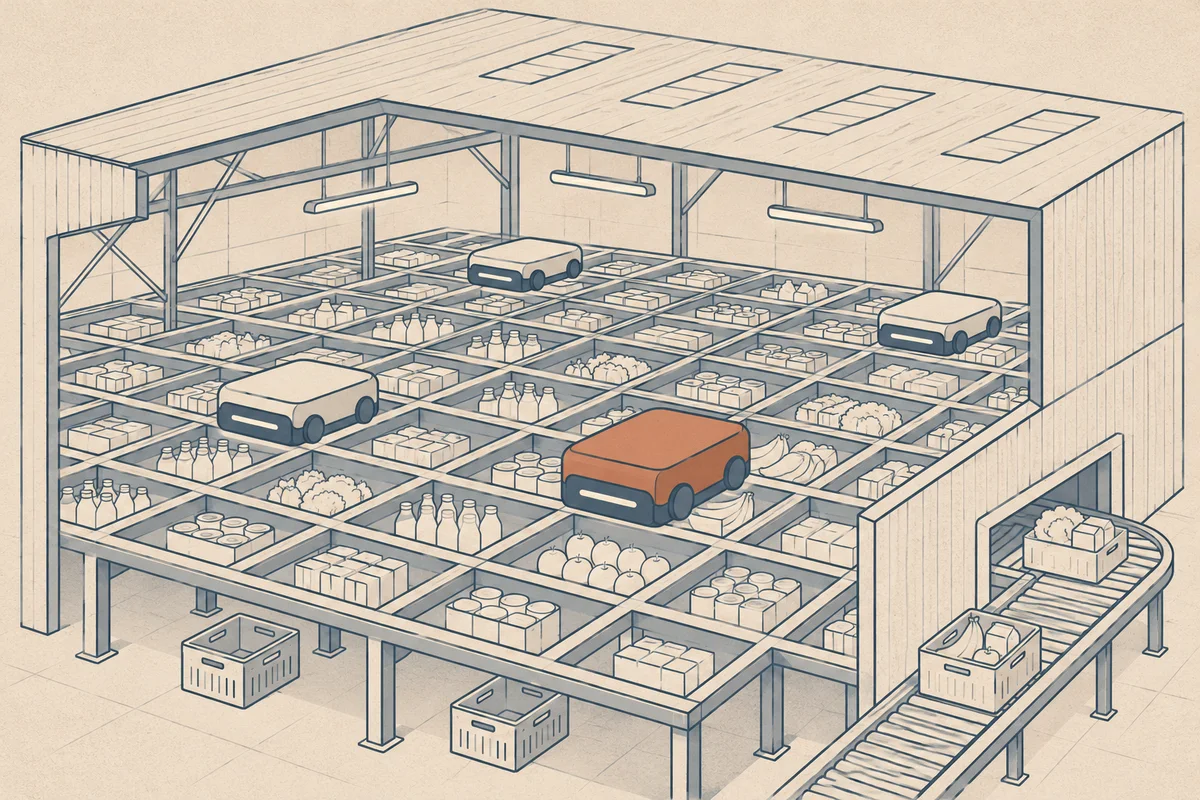
Ocado's solution was to make the process extraordinarily sophisticated.
It built automated warehouses, developed software, designed robotic systems and created a business model intended to transform online grocery retailing.
More than a quarter of a century later, the technology is remarkable.
The financial results are more complicated.
Ocado's 2025 annual report showed revenue of approximately £1.36 billion and adjusted EBITDA of £178 million, yet the business continued to consume cash.
Its 2026 half-year results were further complicated by hundreds of millions of pounds in payments arising from the closure or cancellation of facilities operated by North American partners.
The company has demonstrated that it can build sophisticated grocery technology.
Whether that technology can consistently earn attractive returns on the capital invested remains the central commercial question.
So, let's jump in.
The Origin: When online grocery shopping was a difficult idea
Ocado was founded in Britain in 2000 by Jonathan Faiman, Jason Gissing and Tim Steiner, all former Goldman Sachs bankers.
The company began pilot deliveries in 2001 and opened its first customer fulfilment centre at Hatfield in 2002.
The concept was different from the conventional supermarket model.
Traditional retailers generally used physical stores as the centre of their operations. Customers travelled to the store, selected products and transported them home.
Ocado wanted to organise the entire process around delivery.
Customers would place orders online. Products would be picked and packed at dedicated facilities. Delivery routes would then bring those orders directly to people's homes.
The difficulty was that grocery retailing is not particularly forgiving.
Margins are typically narrow. Products have different storage requirements. Fresh food has a limited shelf life. Customers expect accurate orders, convenient delivery windows and competitive prices.
And, unlike a book or a pair of shoes, a cucumber cannot simply be left in a warehouse for six months while the business waits for demand to improve.
Ocado therefore needed to solve several problems simultaneously: inventory management, order picking, delivery scheduling, route optimisation and product availability.
The company developed technology to manage those processes, supported by increasingly automated fulfilment centres.
Its early grocery business was associated with Waitrose, before its later retail joint venture with Marks & Spencer.
But the company's most significant evolution was still to come.
It began to see itself not merely as a grocery retailer, but as a technology supplier to other retailers.
The Turning Point: Selling the machinery rather than the groceries
Imagine inventing a remarkably efficient restaurant kitchen.
You could use it to operate your own restaurant.
Or you could sell the kitchen technology to thousands of other restaurants.
The second opportunity might be much larger, particularly if the technology genuinely makes those businesses more productive.
Ocado pursued a similar transformation.
Its technology platform combined automated warehouses, robotics, software and logistics capabilities that could be deployed by other grocery retailers.
The company developed partnerships with international businesses including Kroger in the United States, Sobeys in Canada and other retailers across Europe and Asia-Pacific.
Its technology proposition was attractive in principle.
A supermarket chain could use Ocado's expertise rather than independently develop its own sophisticated online fulfilment system.
Ocado would receive fees for technology, services and support.
If the platform worked efficiently and attracted enough customers, both parties could benefit.
Ocado would gain access to international markets without needing to operate every grocery retail business itself.
Its partners could modernise their online operations using an established technology platform.
The attraction was obvious.
A British company could move from delivering groceries in vans to supplying the infrastructure behind online shopping across the world.
There was, however, a complication.
Large automated warehouses require substantial investment, and they work best when enough orders flow through them.
A highly sophisticated warehouse processing too few orders is still an underused warehouse.
It is simply underused in a more technologically impressive manner.
The Business Model: Two very different engines
Today's Ocado Group is not simply the online supermarket familiar to British shoppers.
The group reports two principal operating segments: Technology Solutions and Logistics.
It also has an interest in Ocado Retail, its grocery joint venture with Marks & Spencer, which is accounted for separately rather than consolidated as an ordinary wholly owned operating division.
Understanding that distinction is essential when interpreting the company's financial statements.
Technology Solutions
This division supplies technology and associated services to retail partners.
Its offering includes automated fulfilment systems, software, robotics, maintenance and other support.
Revenue can include recurring fees linked to the installed technology network, alongside non-recurring payments.
The recurring component is attractive because an established technology installation may generate income over several years.
But the economics depend on the terms of individual contracts, the volume of installed capacity and whether partners continue using the systems.
Recurring revenue is not the same as guaranteed revenue.
Logistics
Ocado Logistics provides fulfilment and delivery services, principally supporting UK retail partners.
Its revenue includes charges for operating logistics services.
This is a more operationally intensive activity, involving people, facilities, equipment and transport.
Ocado Retail
The familiar consumer-facing grocery business operates as a joint venture with Marks & Spencer.
It generates sales from customers purchasing groceries.
But those retail sales should not be added indiscriminately to Ocado Group's reported revenue.
The distinction matters because the group is simultaneously a technology provider, logistics operator and investor in a retail business.
That combination can create commercial opportunities.
It can also make the accounts harder to interpret than those of a conventional supermarket.
The Numbers: A profitable-looking headline with an important qualification
Ocado's 2025 financial results showed substantial growth in its reported businesses.
| Financial measure | FY2025 |
|---|---|
| Group revenue | £1,361.5m |
| Technology Solutions revenue | £561.2m |
| Logistics revenue | £800.3m |
| Group adjusted EBITDA | £178.0m |
| Adjusted loss before tax | £353.1m |
| Underlying cash outflow | £213.1m |
The distinction between these measures is revealing.
Revenue increased by 12.1% from the previous year.
Adjusted EBITDA increased from £111.7 million to £178 million.
At first glance, that suggests an improving business.
But adjusted EBITDA excludes depreciation, amortisation, impairment, net financing costs and certain adjusting items.
These exclusions matter enormously for a company that has invested heavily in technology, warehouses and infrastructure.
Ocado reported more than £400 million in depreciation, amortisation and impairment within its adjusted 2025 financial presentation.
The business was therefore still reporting a substantial adjusted loss before tax.
Its underlying cash flow was also negative.
The technology may be excellent, but the accounting cannot be understood by looking at EBITDA alone.
EBITDA is useful. It is not a magical certificate confirming that an expensive business has become economically attractive.
Then came the extraordinary 2026 numbers
Ocado's first-half 2026 results appeared dramatic.
Reported group revenue increased to approximately £1.04 billion, while adjusted EBITDA rose to £432 million.
Those figures were heavily affected by payments and accounting consequences associated with the closure or cancellation of facilities by Kroger and Sobeys.
Ocado separately disclosed performance excluding those closure impacts.
On that basis, first-half group revenue was approximately £684 million, compared with £674 million on the prior-year pro-forma basis.
Adjusted EBITDA excluding closure impacts was £81 million, down from £92 million.
That tells a very different story from the headline increase.
The company also reported an underlying cash outflow of £147 million for the half-year, excluding the closure impacts, compared with £108 million a year earlier.
The lesson is not that the headline numbers were false.
It is that a large one-off contractual payment can make a financial period look extraordinarily profitable without demonstrating stronger ongoing demand for the underlying service.
A business receiving compensation because a customer has closed facilities is not necessarily experiencing the sort of growth shareholders originally hoped to see.
It is rather like celebrating a large insurance payment as evidence that the house is performing brilliantly.
The Difficult Chapter: Kroger and the warehouse problem
Ocado's partnership with Kroger was once a major symbol of its international opportunity.
The American supermarket giant agreed in 2018 to use Ocado's technology to develop automated fulfilment operations.
The ambition was substantial.
But the partnership encountered difficulties.
In November 2025, Kroger announced the closure of several automated fulfilment facilities. Ocado also faced closures involving its Canadian partner Sobeys.
The closures highlighted a difficult commercial question.
Was the problem poor execution at individual facilities, insufficient online demand in particular markets, or a more fundamental limitation in the economics of large, centralised grocery warehouses?
The answer may involve elements of all three.
Large fulfilment centres can be efficient when order volumes are sufficiently high.
But they require substantial investment and can be less attractive when customers are dispersed, demand is uncertain or existing supermarket stores offer a more flexible alternative.
A traditional supermarket chain already has stores close to customers.
Using those stores for online fulfilment may sometimes be less sophisticated than building an automated distribution centre, but it can also require less additional capital.
Ocado has responded by developing a broader range of solutions, including smaller and store-based automation.
That is commercially sensible if different markets require different approaches.
It also represents an important evolution from the assumption that large centralised facilities would be the ideal solution in every market.
The company is learning from experience.
The difficult question is how expensive that learning has been.
Why It Works: Technology that is genuinely difficult to copy
Ocado has spent decades developing an integrated technology platform.
Its systems combine robotics, software, fulfilment processes and logistics expertise.
That integration is important.
A competitor might develop a robot capable of moving products around a warehouse.
Building an entire system that coordinates thousands of products, customer orders, inventory movements, delivery schedules and automated processes is considerably harder.
Ocado's intellectual property, technical expertise and accumulated operational experience are potential sources of competitive advantage.
Its technology can also create switching costs.
Once a retailer has invested in an Ocado-powered facility, replacing the underlying platform may be expensive and disruptive.
That can support long-term commercial relationships.
But there is an important distinction between technology that is difficult to replicate and technology that customers can justify buying.
The first is a question of engineering.
The second is a question of economics.
A highly sophisticated system only creates commercial value when the benefits outweigh the cost of installing and operating it.
This is the central challenge facing Ocado.
Its competitive advantage may be genuine, but it must still be economically useful to customers.
And because its customers are sophisticated retailers with alternative fulfilment options, Ocado cannot assume that technical superiority automatically translates into pricing power.
The most impressive technology in the world is of limited commercial value if customers cannot earn an adequate return from using it.
The Next Chapter: Smaller systems, tighter costs and a new leadership era
Ocado's management has outlined several priorities.
The company is seeking new international technology partners, particularly in the United States.
It is developing more flexible automation solutions, including systems that can operate within or alongside existing retail infrastructure.
It has also announced a significant cost-reduction programme.
In February 2026, Ocado outlined plans to reduce technology and support costs by approximately £150 million, involving around 1,000 job losses.
The changes reflect the company's view that a major period of technology development is nearing completion and that it can operate with a more focused cost base.
They also carry serious consequences for affected employees.
Ocado's half-year results maintained management's ambition to generate positive underlying cash flow in the second half of 2026 and become full-year cash-flow positive in 2027.
Those remain targets, not achievements established by the half-year figures.
The company also announced a succession process under which co-founder Tim Steiner is expected to step down as chief executive at the beginning of its 2028 financial year.
After more than a quarter of a century, Ocado is approaching a significant leadership transition.
The next phase may require a different kind of success.
The business has spent years demonstrating that it can invent, develop and deploy remarkable technology.
It now needs to demonstrate that the technology can generate attractive and sustainable financial returns.
That may require fewer grand announcements and more ordinary evidence of recurring revenue, profitable contracts and cash generation.
For a company built around futuristic robotics, the next breakthrough might be something rather old-fashioned.
Making money.
The Questions That Matter
- Can Ocado win enough new international partners to offset the loss of revenue from closed facilities?
- Will smaller, more flexible automation systems improve the economics for customers, or simply create a different competitive market?
- How much additional capital will be needed before Ocado can generate sustainable positive cash flow?
- Does Ocado's technical advantage translate into genuine pricing power, or do customers ultimately control the economics?
Ocado remains one of Britain's most ambitious technology stories.
Its journey from online grocery pioneer to international automation supplier is remarkable.
But the business also illustrates a fundamental distinction.
Innovation can create extraordinary possibilities.
Only attractive economics turn those possibilities into lasting commercial value.
The robots may have solved the problem of moving groceries around a warehouse.
The harder challenge is ensuring that the money moves in the right direction too.